“Move the Needle” on Opportunities, Deals

How do you “move the needle” on the opportunities, generate new ideas, new deals, achieve revenue targets, etc.? Try the following.

Account Plan, Commitments

  • Set top 5-10 Priorities to achieve per account
  • Build a joint Account Plan with your internal team and customer. Preview the plan with your customer.
  • Set commitments for Key Wins in fiscal year
  • Activities should lead to results, not activity for sake of activity
  • Don’t focus on WHY it CAN’T be done. Figure out WHAT CAN be done.

Research

  • Research the company, industry, look at recent technology deals customer made to understand drivers and triggers
  • Look at potential projects in flight or on the roadmap
  • Read Annual Report, CEO Letters to Investors, check out Investor Relationship section on website, watch quarterly analyst calls with CEO, etc.
  • Research leads to reach out to, opportunities, technology, partners, pain points
  • Research new executive/key contacts, relationship to make, identify potential leads. THEH…
  • Execute marketing campaign e.g. direct reach out via email, warm intro via Email or LinkedIn, email campaign with one pagers, etc. Leverage Business Development team.
  • Research & Discovery on competitors (incld. their wallet share). See where they’re failing.

Build Pipeline

  • Identify a Pipeline of Opportunities and Next Steps to close
  • Identify Pursuit Team to help close it e.g. involve Delivery Solution Practices, Competency Centers
  • Map contacts/ppl inside org to technology topics and assign pursuit teams to them

Communication Plan, QBRs

  • Must Have Recurring Communication Plan with customer stakeholders. See “Build a Communication Plan”
  • Conduct QBR (Quarterly or Semi-Annual Business Reviews) with Stakeholder, Execs

Briefings, Meet, Travel, Face Time, Roadshows

  • Show up, Face to Face, Meet, Travel, Walk the Halls
  • Offer briefings, roadmap, overview, capabilities
  • Offer to meet with your Company’s Execs, CEO, Heads, etc.
  • Invite for Executive Briefings in US, EU, APAC or offshore Delivery Locations
  • Roadshows to evangelize and brief customers on Company’s services, capabilities, strategy.

Relationship Building

  • Build relationship & meet people. With stakeholder peers and their management, their execs
  • Get introduced to key stakeholders (ask for recommendation from existing stakeholders, ask who else we should be talking to about XYZ services we offer)
  • Invite Customers to Social Events e.g. lunch, dinner, Company events, industry shows, etc.
  • Map contacts/ppl inside org that you need to meet and figure out how to meet them via intros, campaigns, direct introduction, direct email, stop by their office, etc.
  • Map some of your Company’s executives to be Exec Sponsor for your specific accounts or Key Executives on your Account
  • Example: Build a leads list using SalesNavigator in LinkedIn, then IM them in LN, ask for warm intro’s, Social Selling

Services & Offerings

  • SOW Renewals – during renewal time of existing SOWs, it’s a good time to pause and have a conversation with customers on what else we could be doing for them, what additional services we can offer, what value add, solutions we can provide, etc. That way you’re having a strategic discussion, expanding/deepening the relationship, becoming more of the value add partner vs. transitionally renewing paperwork
  • Conduct a Briefing or Capabilities Presentation -> Design/Architecture Session/Assessment/Workshop/Service Design -> POC -> Propose a Solution -> Close/Win -> Deliver
  • Get into (or offer) Architecture Design, Discovery Sessions, Workshops, Assessment type Engagements (QA assessment, Mobile strategy discussion and roadmap planning, Innovation Workshops etc.), Business Consulting, etc.
  • Map out Services we provide to customer now vs. services/capabilities available. Look at the gaps, figure out how to fill the gaps e.g. get into DevOps, QA, BI. If we only do Digital, let’s do Core IT
  • Apply Solutions Selling not just “staff aug”. Think about their real pain points. Help them solve those
  • At the onset of the engagement create a Roadmap for Future Development, Phases, Vision, etc.
  • Offer Center Of Excellence (CoE) Setup/Model for QA, Dev, BI, RPA, etc. with end-to-end Services from Business Consulting as part of CoE, Digital, to Development Factory, to QA/Automation, to DevOps, to Support. e.g. digital factory – from design, dev, support to feeding the loop back with analytics
  • Ask WHY? Don’t just “Take an Order” E.g. WHY do you need few more QAs on the project. Keep asking WHY this leads to getting to the real pain points and challenges
  • Plus 1+ ask what else does customer need. e.g. if they need 1 more expert, see if there is need for other expertise. Example: they’re looking for Developer resources, why not ask about Digital, QA, DevOps, Support Needs and add additional team members.
  • Position Consulting Services Offerings
  • Show your Point of View e.g. bring PPT for a discussion
  • Show blueprint, model, or just Power Point of “What good end state looks like”. Show “What good [end state, architecture, solution] looks like”.

Cross-Team Collaboration, “ONE TEAM”

  • Build Strong Team “One TEAM” e.g. DM, SM, AM, Architects, PMs
  • Meet with your team on recurring basis
  • Engage “Big COMPANY TEAM” e.g. Sales, Presales, DSP, ISP, Competency Centers, etc. to help you prepare for meetings, calls, bring them to meetings
  • Bring your Company’s Execs to key meetings

Marketing, Events

  • Identify Joint Marketing Plan (e.g. joint whitepapers, case studies, speaking events, events, PR, etc.)
  • Invite to events, HIMSS, your Company’s internal events, round-tables, etc.
  • Execute a Lead Gen campaign using marketing messaging, customized messaging,  get leads list, emails, call them, follow-up
  • Apply Guerilla marketing i.e. “JUST DO IT”, just call people, just setup meetings by sending calendar invites, etc.
  • Participate in Client Conferences, Events

Partnerships

  • Do we have joint Partner opportunities identified, do we know Partner Account Teams? E.g. Adobe, Sitecore, SAP, MSFT, etc.
  • Meet Partner Account team to go after joint deals, compare notes, account plans, collaborate

Thought Leadership, Innovation

  • Share your Company’s white papers, share public case studies, webcasts. Email, remind about yourself
  • Identify investment budget required e.g. Trainings, POC, White Papers, Events, Innovation Programs
  • Show Innovative approaches that can help their business, e.g. engage Competency Centers to educate, engage “Innovation as a Service Team”
  • Hackathons, Innovation Programs

Starting Engagements – Just In Time (JIT)

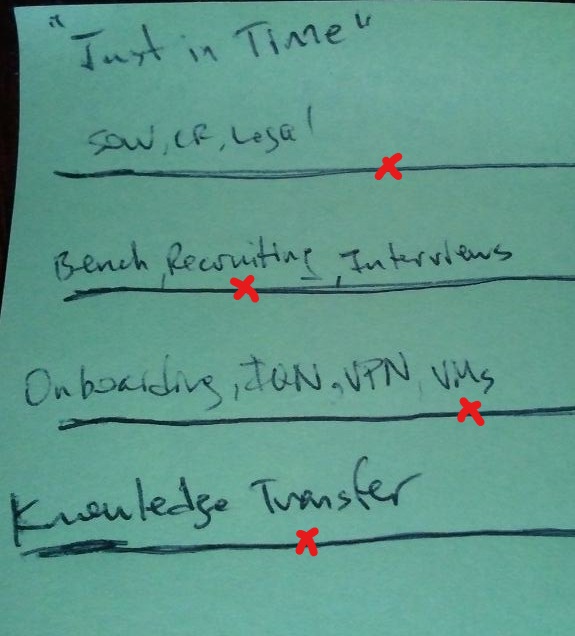
You want to achieve Just in Time (JIT) to align all the parts (swim lanes) below to be done, executed, ready at the same time. The closer you can get them to align, the better.

  • SOW, Change Requests (CR), Legal – paperwork done, executed to allow you to start and recognize revenue on services
  • Bench, Recruiting, Interviews, Team – have the team ready, interviewed, accepted
  • Onboarding, Virtual Machines, VPN, Infrastructure, Office Space – have onboarding procedures done e.g. drug testing, background, have infra, laptops virtual machines, login accounts, IDs, office space, etc. in place
  • Knowledge Transfer – team needs to start learning about the project, consuming materials from the customer about the project, or learning domain, etc. ahead of the project start

This is a sticky note that has been my reference for a long time. Red X’s are for reference purposes, your goal is to line up the X’s as close to each other as possible i.e. Just in Time (borrowed from a manufacturing concept) so everything and everyone is ready to start. That way you don’t have the team lined up sitting idle, waiting for SOWs to be executed or waiting for an official customer onboarding to be done before they can start the engagement. If you’re missing any components, try to move some things up, for example, start the knowledge transfer or customer onboarding, getting VPNs, IDs, environments,  hardware, etc. setup while your team is waiting for an official start date and an executed SOW.

InkedJIT_LI

Improve P&L, Contribution Margins (CM)

Continuously review, optimize your P&L

  • Have a Plan
  • Try to renegotiate the deal, terms
  • Review P&L, Annotations Report and ask for a Model (from Finance Team) that reflects true invoice amounts and true Loaded Costs and Contribution, Account Margins for EACH MEMBER on the team
  • Annual Rate increases, COLA language, understand when and how you can invoke those contractually
  • MSA – renegotiate on terms e.g. payment terms, termination, cost of living, rate increases
  • Rotate, Rebalance team seniority e.g. rotate senior folks out who’ve matured, but don’t jeopardize delivery, balance the model to make it “diamond” shape e.g. Seniors, more Mid-Level, less Juniors
  • Remove shadows and non-billable resources, or make those valuable resources billable
  • Bill for non-billable resources (e.g. PMs, DMs), etc.
  • Move to lower cost delivery locations
  • Switch to Monthly Rates
  • Validate EVERY invoice EVERY month, EVERY line item
  • Validate EVERY Rate for resources
  • Remove unnecessary ISP, DSP flags in CRM and UPSA, they drive up bench and BU cost
  • Level Up resource after promotion, don’t leave them on old rates
  • Don’t forget to invoice for overtime
  • Do you have any Un-billed, Unrecognized Revenue issues to improve?
  • For long term Onshore Trips to US use onsite Rates
  • Review and approve all Travel Expenses. Reduce unnecessary travel, team buildings, etc.
  • Avoid Non-billable expenses, e.g. trips for offshore if non-billable
  • Start Projects Earlier to have more runrate runway during the year
  • Onboard in parallel especially if onboarding is non-billable
  • Escalate Staffing to close open positions
  • Ask Why? E.g. Why they need additional resources, there might be a bigger opportunity
  • Plus 1+ ask what else does customer need. e.g. if they need 1 more expert, see if there is one more to add. Example: they’re looking for Developer resources, why not ask about Digital, QA, DevOps, Support Needs and add additional team members
  • Try to Bill as close to NORM hours every month (T&M projects).
  • Training – If people take training, that should be after hours on their own time, not reducing billable time
  • Evaluate if any past contractual concessions can be remove that are no longer applicable e.g. remove / expire discounts

Build a Communication Plan

When I was starting out in the partner management, account management role in Microsoft, I asked my manager at the time what is the best lesson learned that I can apply to my role to be successful. He thought for a minute and then said, “Have a recurring communication plan with your customers”.

It is one of the most important lessons I’ve learned and applied. The recurring communication plan, scheduled on the calendars, allows you to keep the ongoing dialog going with your customers and stakeholders at different levels. It’s the way you build relationship, rapport, bring thought leadership and value, get insightful feedback, ask for favors, find out about new deals/opportunities, bring up challenging escalations to the surface, improve, etc., etc., etc.

Have a multi-level communication plan withing your Account team, Business Unit and Customer.

For my accounts, I strive to have the following in place, yours will be different, fine-tuned based on your needs

Account Level

  • With the Customer (external communication)
    • Recurring Communication Plan with Customer Stakeholders (QBRs, Monthly, Weekly, etc.)
      • e.g. meet with Execs every 2 months (every 3 months is too far apart)
      • Meet your Customer Execs Direct Reports (and their Directs) e.g. every month or every other week
    • Tips:
      • 1-2 weeks before meeting with Execs, have a 1:1 or your regularly scheduled meeting with their direct reports to prepare
      • Also, ahead of Executive’s Direct reports meeting, meet with your Delivery team to prepare and gain feedback, status updates, risk, any issues, compile questions to ask, agenda, and opportunities that might be broached during Directs and Exec discussions
      • Here is a typical agenda I use with customers, refine/reduce per your needs:
        • Status update
          • Key Accomplishments, Milestones
          • Team(s) feedback – Surface feedback up from your teams
          • Outstanding issues, risks, bottlenecks
          • Risk mitigation
        • Goals, Objectives
          • What’s important to you?
          • What is on top of your mind? Or keeping you up at night?
        • Roadmap
          • What is your roadmap, plans?
          • What business value are you delivering in your next version, release?
          • Why are these things on your roadmap?
          • Why are they important?
        • Improve
          • What obstacles in way?
          • What is not working or working? How do you think we can fix?
          • What should we start or stop doing?
          • What else can we do better or improve your experience of working with us?
          • How can we be useful to you?
        • Collaboration, Thought Leadership
          • What are additional areas for collaboration? 
          • Bring with you any points of view, thought leadership pieces, ideas for collaboration, show “what good looks like” e.g. how other customers are successful implementing XYZ solutions. 

Establish Rhythm of the Business (ROB) with your Account teams and Delivery Teams as well.

  • With your Account Team (internal communication)
    • Have Account All-up Team Syncs (Bi-Weekly) i.e. “One Team” – Account Managers (AM), Sales, Delivery Managers (DM), Business Unit (BU) Management, Delivery Solution Practices, Industry Solution Practices, etc.
    • Account Management, Delivery Teams Syncs (Weekly) i.e. AM, DM, PMs, Tech Leads
    • Staffing (Bi-weekly/Weekly) – Resolve staffing and resourcing issues, build long term plans for skill pools, rotation programs, developing talent, etc.
    • Account Operations (Bi-weekly/Weekly) i.e. Revenue Team, Operations Team to work through Account Receivables, optimizing P&L, Invoicing, etc

Business Unit Level

As a Business Unit Head, you might have the following cadence with your team and direct reports.

  • Business Unit (BU) Level
    • Account Management Plan (AMP) Reviews (Semi-Annually or Quarterly)
    • BU Pipeline Reviews (Bi-weekly)
    • BU All-up Team Syncs (Weekly)
    • BU All-up Delivery Team Syncs (Bi-weekly) or have Delivery participate in the All-up Team Syncs
    • BU Level Staffing Calls – Resolve staffing and resourcing issues across BU, build long term plans for locations, relocation, skills pools, rotation programs, developing talent, etc.
  • Individual Level
    • Account Manager with BU Head or Direct Manager – Personal 1:1s (Bi-weekly/Weekly)

Example of Individual Goals (Delivery is Inherent)

Example of Individual Goals. Even if not all of them get on your annual scorecard for compensation, having those goals in mind will help you expand your relationship, grow account, establish you as though leader and trusted adviser.

  1. Grow X Existing Accounts beyond stretch goal targets
  2. Sustain Y Existing Account(s)
  3. CM over 25% guidance
  4. Intake account(s) over $2M+ with Sales in 2017 into your book of business
  5. Offer New Delivery Solution Practice (DSP) wins (Digital, BI, Big Data, Support, DevOps, Cloud, Mobile, etc.)
  6. Build Relationship, Communication Plan – Recurring meetings with customers, QBRs; Heatmap of expanding relationships to build
  7. Participate in Events, Marketing – PR, Whitepaper, sponsorship, customer joint events, hackathons, events hosting
  8. Show proactive assistance with pre-sales and sales teams, intake of new logos or incoming opportunities, incubation of new accounts. Own the deal end-to-end.
  9. Individually or jointly with Sales/Business Development Team, proactively conduct lead generations campaigns (e.g. leveraging Lead Gen team) against a pre-defined target list and/or existing book of business, materializing in a growth on base of exiting account(s) or new logo acquisition
  10. Delivery – Excellence in Technical Delivery, making sure we deliver on the promise. Delivery, just like Quality is inherent, it’s non negotiable.
  11. Operational Excellence – Keep CRM, Forecasting, Tools, Account Management Plans (AMP), Accounts Receivables (AR), Un-billed Revenue (UB), Billing etc. up to date on ongoing basis